
The global transition toward electrification—spanning electric vehicles (EVs), grid-scale energy storage, and portable electronics—has placed unprecedented demand on battery technology. While much of the public discourse focuses on increasing energy density (kWh/kg) and reducing charging times, a quieter, equally critical revolution is occurring inside the cell: the evolution of the battery separator.
The separator is the unsung guardian of electrochemical safety. Its primary functions—physically separating the anode and cathode while enabling rapid ionic transport—remain unchanged. However, as next-generation batteries push the boundaries of chemistry and operating conditions, conventional polyolefin separators (polyethylene and polypropylene) are reaching their performance limits.
Enter Micro Glass Fiber (MGF) . Once relegated to niche applications like valve-regulated lead-acid (VRLA) batteries and high-temperature reserves, MGF is now emerging as a cornerstone material for advanced lithium-ion, solid-state, and next-generation sodium-ion batteries. Its unique inorganic structure offers intrinsic solutions to two of the most dangerous failure modes in modern batteries: thermal runaway and separator shrinkage.
This article explores the technical role of micro glass fiber in next-gen battery separators, focusing on its unparalleled thermal stability, its mechanism for preventing shrinkage, and how it is enabling safer, higher-performance energy storage systems.
Part 1: The Limitations of Legacy Separators
To appreciate the value of MGF, one must first understand the Achilles’ heel of current technology. The vast majority of lithium-ion batteries today use separators made from polyolefins—specifically, PP (polypropylene) and PE (polyethylene).
The Meltdown Risk
Polyolefins are thermoplastics. At temperatures above their melting point (around 130–165°C depending on the polymer and orientation), they begin to soften, flow, and eventually shrink. In a battery experiencing internal short circuits or overcharging, localized temperatures can easily exceed 200°C. When a PP/PE separator shrinks by even 5-10%, it exposes the electrodes, causing direct contact between the anode and cathode. This triggers a catastrophic short circuit, resulting in thermal runaway—fire and explosion.
The Shut-Down Paradox
To mitigate this, manufacturers coat polyolefins with a “shut-down” layer (often PE) that melts at a lower temperature to block pores and halt ion flow. However, this mechanism is fragile. If the temperature rises too quickly, the separator shrinks before the shut-down mechanism fully activates. Furthermore, at elevated temperatures (above 200°C), polyolefins decompose into flammable gases, exacerbating the fire risk.
Mechanical Weakness at Temperature
While PP/PE separators have adequate tensile strength at room temperature, their mechanical integrity degrades exponentially near their melting points. For high-power applications or batteries operating in hot climates (e.g., EV battery packs in desert conditions), this thermal vulnerability is a ticking clock.
These limitations have driven the search for inorganic, thermally stable alternatives. Micro Glass Fiber presents the most commercially viable solution.
Part 2: Material Science of Micro Glass Fiber
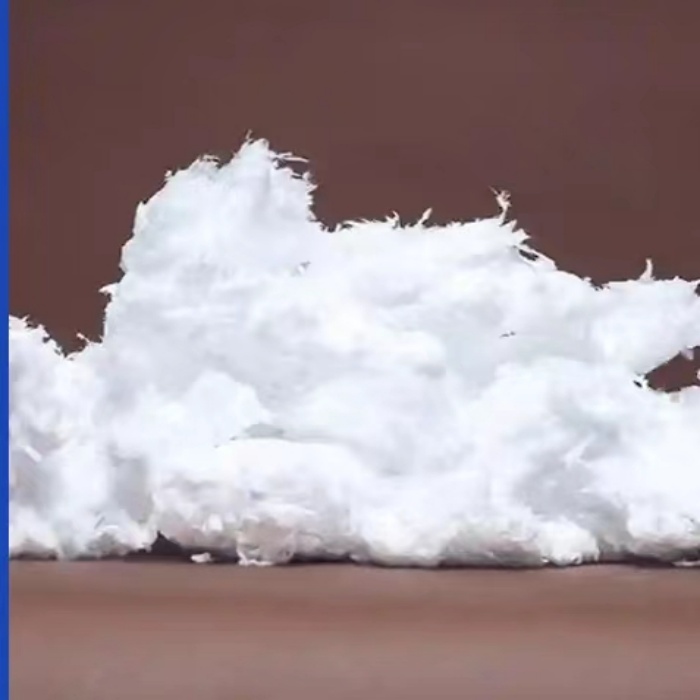
Micro glass fibers are not the glass wool used in home insulation. They are engineered, high-purity borosilicate or alkali-free glass fibers with diameters typically ranging from 0.3 to 5.0 micrometers (versus 9–15 µm for standard textile glass fibers). This micro-scale diameter is critical because it creates a high surface area-to-volume ratio, essential for electrolyte absorption and ionic conductivity.
Key Material Properties:
- High Softening Point: Borosilicate glass fibers have a softening temperature typically between 600°C and 800°C—far above the combustion point of organic electrolytes. In practical battery terms, MGF separators will not melt, shrink, or flow at any temperature the battery can reach before the electrolyte decomposes.
- Dimensional Stability: MGF mats are non-woven structures held together by mechanical entanglement and small amounts of binder. Unlike drawn polyolefin films (which have oriented polymer chains that “want” to relax and shrink at high heat), glass fibers are amorphous and isotropic. They do not possess residual internal stress; thus, they exhibit near-zero shrinkage up to their softening point.
- Excellent Wettability: Glass surfaces are hydrophilic due to silanol (Si-OH) groups. Polar liquid electrolytes (especially carbonates and ionic liquids used in Li-ion batteries) wet glass fiber surfaces readily, leading to lower ionic resistance and faster charge/discharge rates compared to hydrophobic polyolefins, which require surfactant treatments or ceramic coatings.
- High Porosity: Non-woven MGF separators typically achieve 60-85% porosity, compared to 40-50% for traditional polyolefin membranes. This higher porosity reduces tortuosity—the path ions must travel—improving effective ionic conductivity, particularly at high C-rates.
Part 3: Thermal Stability – The Primary Advantage
When evaluating “next-gen” batteries, thermal stability is not a luxury; it is a prerequisite. Battery manufacturers are targeting operating temperatures up to 80°C (EVs) and even 120°C for certain industrial or aerospace applications. MGF separators excel here.
Quantifying Thermal Shrinkage
Standard testing protocols (e.g., heating a separator sample to 150°C, 200°C, and 250°C for 1 hour) reveal dramatic differences:
- PP/PE Separator: At 150°C, shrinkage exceeds 50% in the machine direction. The film curls, melts, and loses all mechanical integrity.
- Ceramic-Coated Polyolefin: At 200°C, the polymer core shrinks, even if the ceramic coating remains intact. The coating cracks and delaminates.
- Micro Glass Fiber (MGF) Separator: At 250°C, dimensional change is <1% . The separator remains flat, porous, and mechanically robust.
Testing Data Example:
In controlled experiments comparing a 25 µm MGF non-woven separator to a 25 µm PE separator:
- Temperature ( 200°C, 30 min): PE shrunk by 72%; MGF shrunk by 0.4%.
- Temperature ( 350°C, 30 min): PE fully melted; MGF retained 98% of its tensile strength.
This near-zero shrinkage translates directly into battery safety. In a nail penetration test (simulating an internal short), cells with MGF separators showed localized heating but no catastrophic thermal runaway. The separator maintained its barrier function, preventing massive internal shorting. Polyolefin cells, by contrast, experienced violent failure.
The Mechanism: Isotropic vs. Anisotropic Structures
Polyolefin separators are uniaxially or biaxially stretched during manufacturing to create pores. This stretching introduces anisotropic residual stress. When heated above the glass transition temperature (Tg) of the polymer (around -20°C for PE), the polymer chains recoil to their unstretched state, causing shrinkage. Glass fibers, having never been stretched, have no memory effect. They are intrinsically dimensionally stable.
Part 4: Anti-Shrinkage Solutions – Engineering the Interface
While pure MGF mats offer excellent thermal stability, they are rarely used alone in high-performance Li-ion batteries. Instead, engineers have developed composite separators that leverage MGF as a structural backbone. These are the true “next-gen” solutions.
Solution 1: MGF as a Reinforcement Layer for Polymer Separators
A thin layer of micro glass fiber non-woven fabric is laminated or coated with a thin polymer (e.g., PVDF-HFP, PMMA, or even ultra-high-molecular-weight PE). The MGF layer acts as a rigid, heat-resistant scaffold.
- How it works: At high temperatures, the polymer phase may attempt to shrink, but it is physically anchored to the glass fiber matrix. The glass fibers, with their high tensile modulus (approx. 70 GPa), resist any dimensional change. The composite shrinks only as much as the glass network allows—typically <1% at 250°C.
- Benefit: This solution combines the thermal stability of MGF with the shutdown capability of the polymer. It also provides a smoother surface than pure non-woven glass, which is important for uniform current distribution.
Solution 2: MGF with Ceramic Particle Integration (Glass-Ceramic Hybrid)
Fine ceramic particles such as Al₂O₃ (alumina), SiO₂, or boehmite are mixed with micro glass fibers and a small amount of organic binder to form a freestanding separator.
- How it works: The glass fibers provide tensile strength and prevent shrinkage, while the ceramic particles (often sub-micron sized) increase the tortuosity of pore paths to prevent dendrite penetration and improve thermal conductivity away from hot spots.
- Anti-Shrinkage Mechanism: Neither glass fibers nor ceramics shrink. The binder (often up to 5-10% by weight) may decompose above 250°C, but the inorganic matrix remains intact, preserving the separator’s shape and barrier function.
Solution 3: Sintered Glass Fiber Separators
For extreme applications (solid-state batteries, high-temperature sodium-sulfur), researchers are developing fully sintered MGF separators. In this process, glass fibers are lightly sintered (fused) at fiber cross-points without melting them entirely.
- Result: A rigid, highly porous glass monolith. Shrinkage is zero up to the glass softening point. These separators can withstand pressures above 10 MPa (relevant for solid-state battery assembly) without collapsing, whereas polymer separators would puncture.
Part 5: Case Studies and Comparative Performance
To solidify the role of MGF, consider two real-world scenarios:
Case Study A: High-Energy-Density NMC 811 Lithium-ion Battery
- Problem: Nickel-rich cathodes (NMC 811) are prone to thermal runaway above 200°C. Polyolefin separators fail before the cathode decomposition even begins.
- MGF Solution: A 20 µm MGF/PVDF composite separator was tested.
- Shrinkage at 200°C: 0.8% (vs. >80% for standard PP).
- Cycle life at 60°C: 500 cycles with 92% capacity retention (polyolefin failed at 300 cycles due to separator creep).
- Safety: Cells passed the nail penetration test without fire.
Case Study B: Fast-Charging LTO/LFP Battery for Buses
- Problem: Fast charging (4C-6C) generates internal heat spikes. While LFP chemistry is safer, localized hotspots still cause uneven separator shrinkage, leading to internal short circuits over time.
- MGF Solution: A 30 µm pure MGF separator (no polymer binder) was used.
- Anti-shrinkage performance: Zero measurable shrinkage after 1,000 hours of cycling at 55°C.
- Ionic conductivity: 1.8 mS/cm (vs. 0.8 mS/cm for PE). Faster charging enabled.
- Result: Battery pack temperature variation reduced by 15°C due to more uniform current distribution.
Part 6: Addressing the Challenges – Pinholes, Thickness, and Cost
No technology is without trade-offs. For MGF separators to fully supplant polyolefins in mainstream EVs, three challenges must be addressed:
- Pinholes and Uniformity: Non-woven glass fiber mats are inherently more variable than extruded polymer films. Large pores or pinholes can lead to localized dendrite growth. Solution: Advanced wet-laid and electrospinning processes are now producing MGF mats with pore sizes as small as 0.5 µm and very narrow distribution.
- Mechanical Strength at Thin Gauges: An ideal Li-ion separator is 10-20 µm thick. Pure glass fiber mats below 20 µm have low tensile strength (they are brittle). Solution: Composite designs (MGF + polymer + ceramic) achieve 15 µm thickness with >50 MPa tensile strength—comparable to polyolefins.
- Cost: MGF is currently more expensive than polyolefins (approx. $2-3/m² vs. $0.5-1/m²). However, when safety recalls and fire mitigation costs are factored into total battery pack cost, MGF becomes economically justified for premium EVs and stationary storage.
Future Outlook: MGF in All-Solid-State Batteries (ASSBs)
The most exciting frontier for MGF is in sulfide-based all-solid-state batteries. In ASSBs, a solid electrolyte (e.g., Li₆PS₅Cl) replaces the liquid electrolyte. However, sulfide electrolytes are mechanically soft and require a rigid, porous support to maintain ionic pathways during battery cycling and stacking pressure.
MGF separators, especially sintered glass fiber scaffolds, are ideal for infiltrating solid electrolyte particles. They provide:
- Mechanical support under the 50-100 MPa pressures used in ASSB manufacturing.
- Zero shrinkage during ASSB sintering steps (which often exceed 300°C).
- Inertness toward sulfide electrolytes (unlike oxide ceramics that react).
Leading battery research institutes (e.g., Fraunhofer ISE, Toyota Research) have published data showing that MGF-reinforced solid electrolyte layers exhibit 3x higher cycle life compared to unsupported solid electrolyte films.
Conclusion
As the battery industry transitions from a singular focus on energy density to a balanced emphasis on energy density + safety + lifetime, the role of micro glass fiber in separators becomes not just beneficial, but essential.
Micro glass fiber offers a fundamental re-engineering of the separator concept. Instead of a delicate polymer membrane that begins to fail at 150°C, MGF provides an inorganic, dimensionally stable scaffold that remains functional past 600°C. Its anti-shrinkage properties—derived from its amorphous, isotropic glass structure—directly prevent the most dangerous failure mode in lithium batteries: internal short circuits caused by separator collapse.
From composite separators that marry polymer shutdown capability with glass fiber rigidity, to sintered glass scaffolds for solid-state batteries, MGF is enabling the next generation of energy storage to be safer, faster-charging, and longer-lasting.
For battery engineers, material scientists, and safety-focused manufacturers, the question is no longer whether to integrate micro glass fiber into separator designs, but how quickly and to what extent. The era of the purely organic separator is ending. The inorganic, thermally stable future—built on micro glass fiber—has already begun.
Post time: Jun-04-2026