
Pasting paper—often referred to in industrial contexts as wallpaper base, laminated pasting paper, or pasted paper products—is a engineered material that demands precision at every stage of production. Whether destined for wall covering applications, bookbinding, or specialized packaging, the manufacturing process involves a complex interplay of fiber selection, chemical formulation, lamination, drying, and rigorous testing. This article provides a comprehensive walkthrough of pasting paper manufacturing, with a focused lens on quality control mechanisms that ensure the final product meets durability, aesthetic, and safety standards from the moment raw materials enter the facility until the finished rolls are loaded onto shipment trucks.
1. Introduction: Defining Pasting Paper in the Modern Context
The term “pasting paper” encompasses a family of paper products where adhesion—either through internal chemical bonding or external lamination with adhesives—plays a central role in the material’s function. In the wall covering industry, pasting paper typically refers to the base substrate (often pure paper or non-woven) that receives a paste adhesive during installation, or to laminated structures where a face sheet is bonded to a backing via a cross-linking adhesive . In stationery and bookbinding, pasting paper may involve sheets joined through controlled paste application to form multilayer products .
Regardless of the specific end-use, the manufacturing workflow shares common critical control points: fiber preparation, web formation, adhesive formulation, lamination or coating, drying and calendering, and final conversion. Each stage introduces variables that must be measured, adjusted, and verified before the product can be released.
2. Raw Material Selection and Incoming Quality Control
2.1 Fiber Furnish
The foundation of any quality pasting paper is the fiber furnish. For pure paper-based wall coverings, manufacturers typically use virgin wood pulp—either bleached softwood kraft for strength or hardwood for smoothness and printability. Non-woven variants incorporate cotton, linen, or synthetic fibers such as polyester, blended to achieve specific tactile and tensile properties .
Incoming fiber undergoes rigorous testing. Key parameters include:
- Fiber length and freeness: Determined through standard pulp testing; shorter fibers improve formation and smoothness, while longer fibers enhance tear resistance.
- Moisture content: Critical for consistent refining and paper machine stability. Chips or pulp bales with excessive moisture can cause inconsistent beating and strength variation.
- Contaminant screening: Recycled fiber, if used, must be screened for ink residue, adhesives (stickies), and mineral fillers that could disrupt web formation or cause defects in the final sheet.
2.2 Chemical Additives and Adhesives
Pasting paper manufacturing relies on a spectrum of chemical agents. Wet-strength resins (often acrylic or phenol-based) are added to the pulp or applied at the size press to ensure the paper resists tearing when wet paste is applied during installation . For laminated products, the adhesive system is equally critical. Polyvinyl acetate (PVA) emulsions with melamine-formaldehyde cross-linking agents are common for vinyl-to-paper laminates, providing moisture insensitivity after curing .
Incoming adhesives are tested for solid content, viscosity, pH, and cure behavior. A batch of PVA adhesive with incorrect viscosity can lead to starved glue lines (poor bond) or squeeze-out (contaminated equipment and uneven surfaces).
2.3 Pigments and Functional Fillers
For opaque, bright pasting papers, mineral fillers such as calcium carbonate or titanium dioxide are incorporated. Flame-retardant variants may include aluminum hydroxide or hydrated calcium borate mineral matter, compounded at precise weight percentages (e.g., 27–57.6% by weight for aluminum hydroxide-based mineral matter) to meet safety regulations . Incoming fillers are verified for particle size distribution and purity, as agglomerates can create surface defects or weaken the sheet.
3. Pulp Preparation and Web Formation
3.1 Refining and Stock Preparation
The refined pulp is metered into the stock preparation system, where consistency, pH, and additive dosing are continuously monitored. For pasting paper intended for wall covering, the stock typically targets a freeness that balances drainage on the wire with formation uniformity. Excessive refining produces a dense, slow-draining stock that can cause flocculation and poor basis weight profiles.
3.2 Paper Machine Wet End
On the Fourdrinier or gap former, the dilute stock is deposited onto the forming fabric. Quality control at this stage focuses on:
- Basis weight uniformity: Measured by beta gauges scanning across the web; variation beyond ±3.5% (for high-grade printing papers) indicates headbox issues or inconsistent stock delivery .
- Formation index: Visual or automated analysis of fiber dispersion; poor formation leads to weak spots and uneven adhesive absorption.
- Drainage and dewatering: Controlled via vacuum boxes and foils; improper drainage causes sheet breaks or inconsistent moisture entering the press section.
3.3 Pressing and Drying
The wet web passes through press nips to remove water mechanically, then over steam-heated cylinders for thermal drying. Moisture content at the reel is a critical quality attribute. For glassine-type pasting papers, target moisture at the calender entrance is carefully controlled to achieve densification and smoothness; excessive moisture causes sticking and sheet breaks, while insufficient moisture yields a brittle, rough sheet .
4. Adhesive Application and Lamination
4.1 Paste Application Systems
For products requiring lamination—such as duplex wallpaper where a vinyl face sheet is bonded to a paper backing—the adhesive is applied via reverse roll coating, knife coating, or gravure application. The paste nozzle systems used in booklet-style pasting paper manufacturing apply adhesive to selected sheet surfaces before stacking and pressing .
Critical control parameters include:
- Coating weight: Measured by gravimetric sampling or inline near-infrared sensors. Insufficient adhesive causes delamination; excess adhesive bleeds through the face sheet, staining the printed surface.
- Adhesive viscosity and temperature: PVA emulsions are shear-sensitive; pumps and coating heads must maintain consistent shear rates to avoid viscosity drift.
- Cross-linking cure: For moisture-resistant bonds, the adhesive must be cured (often via controlled heating) to render it insensitive to water-based pastes applied during installation . Incomplete cure results in bond failure when the end-user wets the paper.
4.2 Nip Pressure and Combining
The face sheet and backing are joined at a combining nip. Nip pressure must be uniform across the web width; uneven pressure creates air pockets or wrinkles that cannot be removed by subsequent calendering. Automated nip control systems adjust hydraulic pressure based on web speed and thickness feedback.
5. Drying, Calendering, and Surface Treatment
5.1 Post-Lamination Drying
After lamination, the web passes through a post-calendering drying section. Here, chromed drying cylinders with very smooth surfaces (roughness Ra ≤ 0.1 μm) are used to maintain or improve the surface quality achieved in preceding steps . Temperature and tension are controlled to prevent curl and to complete adhesive curing without over-drying, which would embrittle the paper.
5.2 Calendering for Smoothness and Density
Calendering—passing the web through a stack of hard, polished rolls—imparts the smoothness necessary for high-quality printing and consistent paste absorption. For pasting paper, the calender also controls thickness and density. Trial data from glassine paper production (a dense, translucent paper sometimes used as a pasting substrate) showed that with optimized moisture at the calender entrance, standard deviation of thickness can be held below 1.7 μm, with density reaching approximately 1.1 g/cm³ and transparency exceeding 50% .
5.3 Surface Sizing and Functional Coatings
Some pasting papers receive a surface size or functional coating to modulate paste absorbency. A paper that absorbs paste too rapidly may swell unevenly, causing bubbles during installation; one that repels paste will fail to adhere. Surface protecting agents—comprising water-soluble urethane, acrylic, or melamine resins—may be applied at 30–80 g/m² via gravure or knife coating to provide abrasion resistance and anti-pollution properties .
6. Printing and Embossing (Where Applicable)
For decorative pasting papers (wall coverings), printing and embossing follow the base paper production. Rotogravure or flexographic presses apply water-based acrylic inks in register. Quality control at this stage includes color consistency (spectrophotometric measurement against standard), registration accuracy, and ink adhesion (tape pull tests).
Embossing—pressing the paper against an engraved chilled roller while the surface is heated—creates relief patterns. For vinyl-laminated products, the vinyl layer must possess sufficient natural softness and stretch to accept deep embossing without pre-softening . Embossing depth and pattern fidelity are inspected visually and via profilometry.
7. Quality Control Testing: From Bench to Batch Release
7.1 Sampling Protocols
Finished rolls are sampled according to standardized procedures. A typical protocol for paper products involves randomly selecting packages from each batch, extracting sheets, and conditioning them in a standard environment (23 ± 1°C, 50 ± 2% relative humidity) for at least 24 hours before testing .
7.2 Physical and Mechanical Tests
|
Test |
Method / Instrument |
Acceptance Criterion (Example) |
|
Basis weight |
Gravimetric, 100 cm² samples | ±3.5% of nominal for premium grade |
| Thickness | Micrometer | ±8% deviation |
| Tensile strength | Tensile tester, strip method | ≥40 N·m/g (machine direction, premium) |
| Tear resistance | Elmendorf tear tester | Specified minimum based on grade |
| Smoothness | Bekk or Bendtsen | ≥45 s (Bekk, premium face) |
| Opacity | Diffuse reflectance | ≥84% for 60 g/m² |
| Water absorption | Cobb test | 15–40 g/m² (controlled absorbency) |
| Folding endurance | MIT or Schopper | ≥12 double folds (transverse) |
7.3 Visual and Dimensional Inspection
Under standardized D65 illumination at 500 mm viewing distance, inspectors check for holes (none exceeding 0.5 mm diameter), visible impurities (≤1 per m²), and wrinkles . Color uniformity is verified by measuring ISO brightness at multiple points across the web; for decorative papers, a whiteness difference ≤1.5% between samples is required .
7.4 Adhesion and Lamination Integrity
For laminated pasting papers, peel strength testing quantifies the bond between face and backing. Samples are cut to standard width, the layers are separated at a controlled rate, and the average force is recorded. Moisture resistance of the adhesive is tested by conditioning bonded samples in high humidity or by applying simulated paste and observing for delamination over 24 hours.
8. Defect Analysis and Process Feedback
Quality control is not merely a gatekeeping function; it drives continuous improvement. When a batch fails a test—say, basis weight variation exceeds tolerance—the quality team traces the deviation back through the process data. Headbox slice lip adjustments, stock consistency changes, or refiner power fluctuations may be implicated. Statistical process control (SPC) charts for key variables (basis weight, moisture, caliper, adhesion strength) are maintained, with control limits set based on historical capability.
Modern paper machines integrate quality control systems (QCS) with scanning frames that measure basis weight, moisture, caliper, and ash content at multiple points across the web, updating every few seconds. These systems feed automatic actuators—headbox dilution valves, steam pressure controllers, calender nip loaders—to keep the process centered .
9. Packaging and Shipment
9.1 Roll Wrapping and Protection
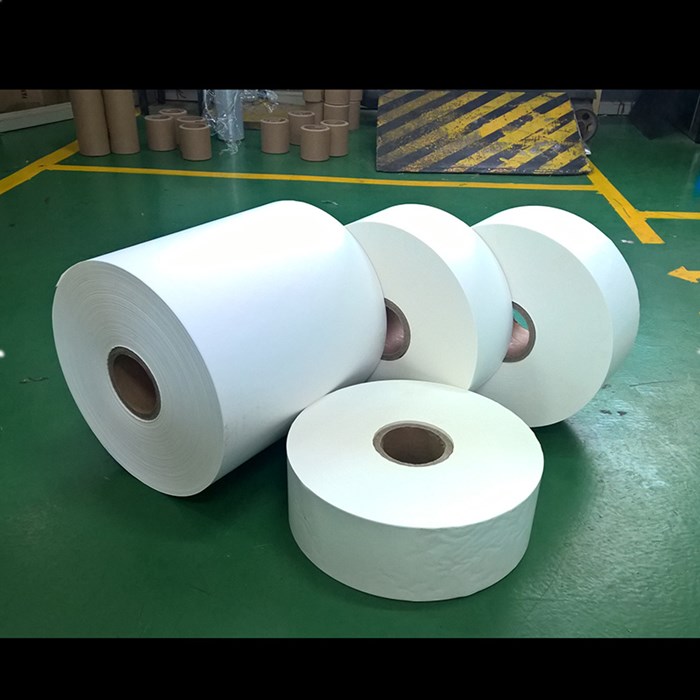
Finished pasting paper rolls are wrapped in moisture-barrier film (typically polyethylene-coated paper or stretch wrap) to protect against humidity changes during transit. Roll ends are protected with edge protectors; for high-value decorative papers, desiccant packets may be inserted. Each roll is labeled with batch number, basis weight, width, length, and production date for traceability.
9.2 Palletizing and Loading
Rolls are palletized vertically or horizontally depending on customer requirements and shipping method. Pallets are stretch-wrapped and banded. During loading, care is taken to avoid compression damage to roll edges; damaged edges can cause web breaks at the customer’s printing or converting facility.
9.3 Final Release Documentation
A certificate of analysis (CoA) accompanies each shipment, summarizing test results for the batch. This document provides the customer with assurance that the pasting paper meets agreed specifications. For regulated markets (e.g., wall coverings with flame-retardant claims), additional compliance declarations may be required, referencing test standards and pass/fail results.
10. Conclusion
The manufacture of pasting paper is a discipline of precision. From the selection of virgin pulp and the formulation of moisture-resistant adhesives to the micron-level control of calendering and the final visual inspection under standardized lighting, every step is governed by measurable criteria. Quality control is not a final checkpoint but a continuous thread woven through the entire production chain. As the industry moves toward more sustainable materials—biodegradable resins, recycled fibers, and reduced-energy drying—the fundamentals of rigorous testing and process control remain unchanged. For manufacturers, the ability to document and verify quality from raw material to shipment is not only a competitive advantage but a prerequisite for trust in an increasingly regulated and environmentally conscious marketplace.
Post time: Nov-12-2026


