
In an increasingly digital world, the need for secure physical documentation has not diminished—it has evolved. From tax invoices and customs declarations to medical records and high-value contracts, the integrity of paper documents remains paramount. While standard carbonless paper (NCR paper) revolutionized the creation of multi-part forms, today’s global market demands more: high-security and anti-counterfeit features that are deeply integrated into the paper itself.
China, as a global leader in specialty paper manufacturing, has moved beyond basic production to become a hub of innovation in this field. Chinese manufacturers are deploying sophisticated, multi-layered security technologies to protect against forgery, alteration, and unauthorized duplication. This article explores these cutting-edge solutions, demonstrating how the industry is meeting the stringent demands of finance, government, and enterprise sectors.
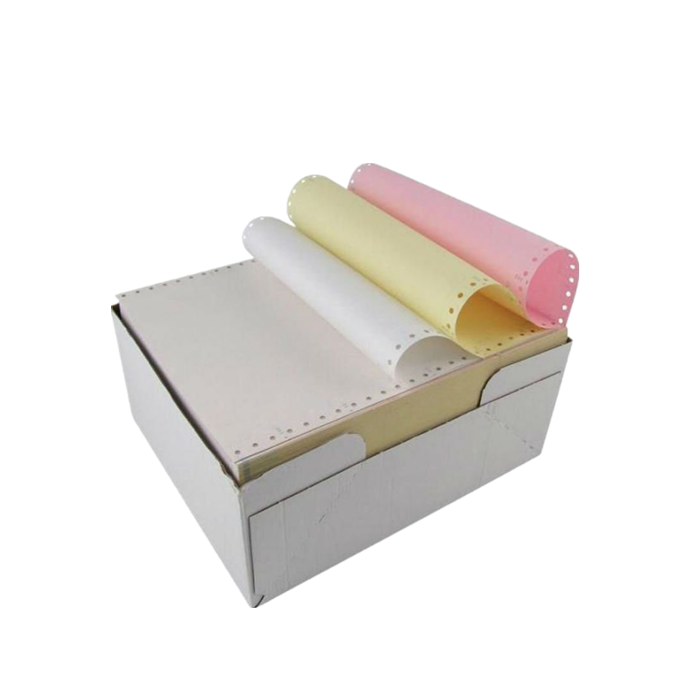
The Foundation: Multi-Layered Security Architecture
The philosophy behind modern anti-counterfeit carbonless paper is defense in depth. Relying on a single security feature is no longer sufficient. Instead, Chinese manufacturers integrate multiple “levels” of security that interact with each other. These features are categorized into visible (overt), machine-readable (covert), and forensic (requiring lab analysis) layers. This multi-tiered approach makes it exponentially more difficult for counterfeiters to replicate a document successfully.
Advanced Security Features in Chinese Carbonless Paper
Chinese manufacturers are pioneering several high-tech security features that are now being integrated into carbonless paper products.
1. Thermochromic and Chemical Sensitivity
Advanced security papers now respond to environmental stimuli. For instance, thermal-discoloration carbonless paper reveals unique anti-counterfeit points or patterns when subjected to specific temperature conditions. This self-developed technology offers high concealment and confidentiality, as the security feature lies dormant until activated by heat, making forgery extremely difficult.
Similarly, high-security papers incorporate chemical sensitivity. Any attempt to alter the document using solvents, acids, or bleach will damage the paper’s coating, causing a visible stain or discoloration. This provides immediate evidence of tampering.
2. Invisible Fiber Technology
Rather than relying on visible printed marks, security can be embedded within the paper’s very structure. Manufacturers produce anti-counterfeit fiber paper by integrating specialized security fibers into the pulp during the papermaking process. These fibers possess specific properties—including unique color phases, fluorescence excitation wavelengths, and thickness—that are exclusive to the manufacturer. Because these fibers are physically bonded with the paper base, they cannot be removed or replicated through coating or printing, offering robust protection against forgery.
This technology is often enhanced with invisible fluorescent fibers. These are detectable only under ultraviolet (black) light, providing a covert verification method for bank tellers, customs officials, and medical professionals.
3. Invisible Watermarks
Traditional watermarks are visible when held up to light. However, Chinese papermakers have developed advanced invisible watermark anti-counterfeit paper. This technology uses the physical and chemical properties of paper fibers to create a watermark that is not visible under normal conditions. Instead, it only appears when the paper is dampened with a small amount of water and disappears upon drying. This provides a unique, easy-to-verify authentication method that is far more sophisticated than standard watermarks.
4. Dual-Color and Covert Imaging
To further enhance security, some manufacturers now offer two-color anti-counterfeit carbonless paper. This feature goes beyond simple color copying, offering multi-level anti-counterfeiting that includes both direct visual security features and deep, more hidden covert performance.
In practical applications, this may involve the use of coin-reactant inks that change color when rubbed with a coin, or the inclusion of void pantographs. A void pantograph is a background pattern that remains hidden to the naked eye but reveals the word “VOID” or similar text when the document is photocopied or scanned, instantly identifying it as a copy.
Industry Capabilities: The Chinese Manufacturing Landscape
China’s emergence as a leader in this field is underpinned by its significant manufacturing capabilities and government backing. Key players like China Paper Corporation, a wholly-owned subsidiary of a state-owned capital operating company, lead the market in carbonless paper production. The company owns multiple listed subsidiaries and operates production bases with a combined capacity of over 3.5 million tons, ranking sixth in the national pulp and paper industry. This scale allows for massive investment in R&D for specialty security products.
Another major player, Guangdong Guanhao High-Tech Co., Ltd. , specializes in the production of thermal and carbonless copy paper, including their microcapsules. The company supplies specialized thermal paper used for China’s sports and welfare lotteries, civil aviation boarding passes, and train tickets. Their carbonless paper is a standard for tax, postal services, and banking documents across the country.
Furthermore, companies like Henan JiangHe Paper Co., Ltd. have become key exporters with over 20 years of experience in the specialty paper market. With an annual production capacity exceeding 600,000 tons and certifications including ISO 9001 and FSC-COC, JiangHe produces carbonless paper that meets international security standards, delivering products with security fibers as a primary option for customers. Similarly, Shandong Lixing New Materials Technology Co., Ltd. offers OEM/ODM customization, allowing international clients to incorporate specific security features into their paper products.
Applications Across Critical Sectors
The primary demand for high-security carbonless paper comes from sectors where document integrity is non-negotiable:
- Taxation and Finance: Used for VAT invoices, tax forms, and bank checks to prevent fraud and ensure accurate revenue collection.
- Customs and Logistics: Ensures the authenticity of customs declarations, bills of lading, and waybills, preventing smuggling and cargo theft.
- Medical and Insurance: Protects patient records, prescriptions, and insurance claims from tampering or identity theft.
- Legal and Government: Secures contracts, official certificates, and titles against forgery.
Conclusion
The days of simple carbon paper are long gone. To combat sophisticated counterfeiting, the industry has developed “smart paper” that combines chemistry, materials science, and covert marking technologies. Chinese manufacturers are at the forefront of this trend, offering a comprehensive range of solutions—from invisible watermarks and thermal-reactive coatings to embedded security fibers and void pantographs.
As global threats to document security evolve, China’s paper industry continues to innovate, providing high-quality, reliable, and scalable solutions that help businesses and governments protect the integrity of their most critical documents. For organizations seeking to go “beyond the basics,” the anti-counterfeit carbonless paper coming out of China represents the state of the art in secure documentation.
Post time: Jul-16-2026


