
Why Paper Specifications Matter More Than You Think
When ordering labels, self-adhesive paper, or any pressure-sensitive material, the specifications you choose determine everything that happens downstream. A label that prints beautifully but fails to adhere in a freezer is worthless. A paper stock that feeds smoothly through a laser printer may jam a thermal transfer printer if the caliper is off by a few thousandths of an inch. And a roll that runs flawlessly at low speed may tear apart during high-speed converting because the release force exceeds the face paper’s internal strength.
This guide breaks down the three most critical specifications—width, thickness, and adhesive—into practical terms. Whether you are a print buyer, converter, or product manager sourcing label materials, understanding these parameters will help you avoid costly mistakes and specify materials that perform exactly as intended.
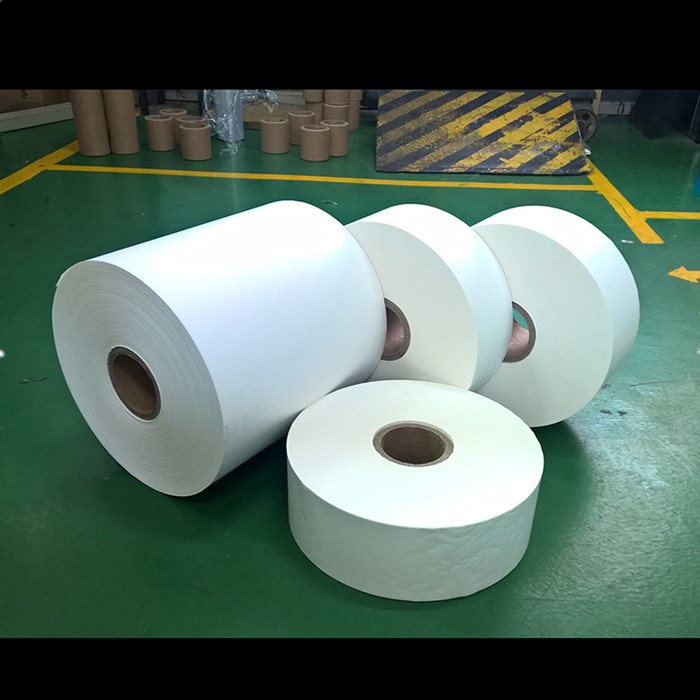
1. Width: More Than Just a Dimension
Width might seem like the simplest specification on the list. You need a label that fits a package, so you order a 4-inch-wide roll. But in the world of pressure-sensitive materials, width interacts with converting speed, machine compatibility, and waste rates in ways that are not always obvious.
The Relationship Between Width and Converting Speed
Research on laminate converting shows that web width directly affects the maximum speed at which a material can be processed. In controlled experiments comparing 135 mm and 155 mm wide webs, the narrower web exhibited a more moderate relationship between release force and converting speed, while the wider web showed a steeper increase in speed as the ratio of release force to face paper strength changed . What this means in practice is that wider webs require more careful balancing of adhesive release properties against paper strength. If the release force is too high relative to the paper’s tensile strength, the web will break during converting. If it is too low, the labels may detach from the liner and “bleed” during high-speed application .
Width and Printer Compatibility
Every printer has a maximum media width. For desktop label printers, this might be 4 inches. For industrial thermal transfer printers, it could be 8 inches or more. Exceeding this limit causes jams and potential printhead damage. But width also affects the minimum. Very narrow webs can wander laterally (cross-direction movement) during high-speed feeding, causing print misregistration and die-cut inaccuracy . If you are running a narrow label on a wide-format printer, you may need a carrier sheet or a wider liner to maintain stability.
Practical Takeaway on Width
When specifying width, consider the full journey of the material: the converting press, the printing method, and the application equipment. A width that works perfectly for flexographic printing may be problematic for a desktop laser printer. Always confirm the maximum and minimum media widths for every machine in the supply chain.
2. Thickness: The Specification That Hides in Plain Sight
Thickness—often called caliper—is where confusion runs rampant. The paper industry uses at least three different systems to describe the same physical property, and none of them translate cleanly across categories.
Caliper, Weight, and Bulk: A Vocabulary Lesson
Caliper is the actual measured thickness of a sheet, expressed in mils (thousandths of an inch) or microns. A sheet measuring 0.010 inches thick is 10-point, or 10 mil . In metric units, that same sheet would be 254 microns .
Basis weight is the weight of a ream (500 sheets) in a specific base size. The problem is that different paper grades use different base sizes. Bond paper uses 17 x 22 inches. Text paper uses 25 x 38 inches. Cover paper uses 20 x 26 inches. This means a 100 lb cover stock is not twice as heavy as a 50 lb cover stock in any meaningful physical sense—it is a completely different grade with different base dimensions .
GSM (grams per square meter) is the great equalizer. Because it measures the weight of a one-meter-square sheet, it provides a uniform scale regardless of paper grade . A 170 gsm coated sheet and a 170 gsm uncoated sheet weigh the same per square meter, but they may have very different calipers. Coated papers are calendered (pressed between rollers) during manufacturing, which densifies the sheet and reduces thickness for a given weight. Uncoated high-bulk papers retain more air and feel thicker despite identical GSM .
Why Thickness Matters for Different Applications
For laser and inkjet printing, caliper affects feeding reliability. Paper that is too thin may curl or misfeed. Paper that is too thick may exceed the printer’s fuser clearance. Most desktop printers handle 20–24 lb bond (approximately 75–90 gsm, or 3.5–4.5 mils), while heavy cardstock at 12–14 points may require a straight-through paper path .
For bookbinding, caliper determines spine width. If you are producing a perfect-bound book with 200 pages of 90 gsm text stock and then switch to a 70 gsm stock, the spine will be narrower and the cover will not fit. Creep compensation in saddle-stitched booklets also depends on caliper: thicker paper causes inner pages to push outward more than thin paper .
For label converting, total caliper (face stock plus adhesive plus liner) affects die-cutting, matrix stripping, and dispensing. Thinner constructions allow more labels per roll and are preferred for hand application, but they offer less structural support during high-speed dispensing. Adhesive coat weights typically range from 0.0004 to 0.0012 inches for smooth surfaces, and up to 0.0025 inches for textured surfaces where the adhesive must fill gaps .
A Practical Warning About Thickness Assumptions
Never assume that GSM equals thickness. A 170 gsm coated paper and a 170 gsm uncoated paper have the same weight but different calipers. If thickness matters for your application—whether for postal regulations, spine calculations, or printer compatibility—request the caliper in mils or microns from your supplier. Do not rely on weight alone .
3. Adhesive: Where Labels Succeed or Fail
The adhesive is the functional heart of any pressure-sensitive product. It determines whether a label stays put for years or peels off cleanly without residue. It dictates performance in cold warehouses, hot car interiors, and humid greenhouses. And it interacts with the face stock and the application surface in ways that are not always intuitive.
The Three Functional Categories
Permanent adhesives form a bond that strengthens over time. After 24 hours, the adhesive achieves its full holding power. Attempting to remove a permanent label typically results in face stock failure—the label tears—rather than clean adhesive release . This is the standard choice for shipping labels, product identification, and asset tags where the label should never be removed intact.
Removable adhesives allow clean peeling after a defined period. They have lower tack strength than permanent adhesives, sometimes achieved by adding non-tacky fillers that reduce the effective bond area . Removable adhesives are ideal for pricing labels, temporary promotions, and any application where the label must leave no residue.
Repositionable adhesives sit between permanent and removable. They allow multiple placements before final adhesion sets. This category is useful for labels that must be aligned precisely during application but should not be removable once positioned .
The Chemistry Behind Performance
Adhesive performance is not just about category—it is about chemistry. The two most common families are rubber-based and acrylic-based adhesives.
Rubber-based adhesives offer excellent initial tack and quick-stick properties. They bond aggressively to a wide range of surfaces, including corrugated cardboard, polyethylene films, and metal. However, they have limited resistance to UV light and high temperatures. Rubber-based adhesives are typically more economical than acrylics but may yellow or lose tack when exposed to prolonged sunlight .
Acrylic adhesives start with lower initial tack but build to a permanent bond within 24 hours. They offer superior resistance to UV light, oxidation, and temperature extremes. For outdoor applications, cold storage, or any environment where the label will face environmental stress, acrylics are the preferred choice . Some acrylic formulations are specifically engineered for frozen surfaces, maintaining tack even at deep-freeze temperatures.
Surface Energy: The Hidden Variable
Adhesive selection is meaningless without considering the surface to which the label will be applied. Surface energy determines how well an adhesive can “wet out” and bond. High-surface-energy substrates like PET, glass, and metal accept adhesives readily. Low-surface-energy substrates like polypropylene (PP) and polyethylene (HDPE/LDPE) resist adhesion because the adhesive cannot flow into the surface irregularities effectively .
For low-surface-energy plastics, high-tack acrylic or rubber-based adhesives are required. For textured or powder-coated surfaces, modified acrylics with higher coat weights fill the gaps and create a reliable bond. For rough or porous surfaces like wood and cardboard, rubber-based adhesives provide superior initial grab and penetration .
Temperature: The Often-Overlooked Factor
Adhesive performance is temperature-dependent in two distinct ways: application temperature and service temperature.
Application temperature is the temperature at which the label is applied to the surface. Most standard adhesives require a minimum application temperature of around +5°C (41°F). Below this threshold, the adhesive becomes too firm to wet out properly, and the label may not adhere at all. For cold-storage labeling, specialized adhesives maintain tack at temperatures well below freezing .
Service temperature is the range the label will experience after application. Standard pressure-sensitive adhesives typically withstand -20°C to +80°C. For automotive under-hood applications, electronics, or industrial equipment, high-temperature acrylics or silicone adhesives extend this range significantly .
A label that adheres perfectly at room temperature but fails at -10°C in a freezer is not a manufacturing defect—it is an adhesive mismatch. Always specify both application and service temperature requirements when sourcing labels.
Putting It All Together: A Specification Checklist
When writing paper specifications for labels or self-adhesive materials, work through this checklist to ensure every parameter is covered:
Width
- Maximum and minimum width for converting equipment
- Maximum and minimum width for printing equipment
- Maximum and minimum width for application equipment
- Roll core diameter and maximum roll diameter
Thickness (Caliper)
- Face stock caliper (in mils or microns)
- Adhesive coat weight (in mils or microns)
- Liner caliper (glassine vs. PET film, and thickness)
- Total construction caliper
- Printer clearance specifications
Adhesive
- Functional type (permanent, removable, repositionable)
- Chemistry (rubber-based, acrylic, or specialty)
- Minimum application temperature
- Service temperature range
- Surface energy compatibility (HSE vs. LSE substrates)
- Special requirements (FDA compliance, UL approval, wash-off capability)
Conclusion
Pasting paper specifications is not a clerical exercise. Width, thickness, and adhesive are interdependent variables that determine whether a material will run smoothly through converting, print clearly, and perform reliably on the final surface. A mismatch in any one of these areas can cascade into production downtime, wasted material, or field failures that damage a brand’s reputation.
The next time you order labels or pressure-sensitive paper, do not simply repeat last year’s purchase order. Re-examine the application. Has the storage temperature changed? Has the packaging substrate been reformulated? Has the converting line been upgraded to higher speeds? These changes may require a revised specification. A little attention to width, thickness, and adhesive now will save considerable frustration later.
Post time: Oct-15-2026


